


Wireless Emergency Alerts are the short, loud messages that appear on a phone when a tornado warning, flash flood warning, hurricane warning or AMBER Alert is issued for the area around it. This article explains who originates those alerts in Florida, how they travel through the national Integrated Public Alert and Warning System and cellular networks to capable phones, why one phone receives an alert while the phone beside it stays silent, and what Figgers customers should check now, with a full month of hurricane season still ahead.
Florida gets more practice with emergency alerts than most states. Hurricane warnings arrive from the Gulf and the Atlantic, tornado warnings can be issued in any month, and flash flood warnings are routine in the low lying urban corridor that runs from Palm Beach County through Broward County to Miami Dade. The alert that interrupts dinner with a jarring tone is easy to take for granted, and just as easy to silence by accident in a settings menu. Understanding how the system works is the best way to make sure it works for you.
Florida's warning season does not end in October
The National Hurricane Center's climatology page states that the Atlantic hurricane season runs from June 1 to November 30, with the statistical peak on September 10 and most activity between mid August and mid October. That leaves a full month of the 2026 season open when this article is published. Tornado warnings and flash flood warnings do not follow a season at all. In Florida they can be issued in January as readily as in August, on the Treasure Coast, across the Panhandle, around Tampa Bay and throughout South Florida.
The National Weather Service pushes a specific set of its warnings through Wireless Emergency Alerts: tornado warnings, flash flood warnings that carry a considerable or catastrophic damage threat tag, hurricane warnings, storm surge warnings, extreme wind warnings and severe thunderstorm warnings tagged as destructive. Every one of them is a realistic possibility somewhere in Florida during the next thirty days.
What a Wireless Emergency Alert is and who can send one
Wireless Emergency Alerts, usually shortened to WEA, are one delivery channel of the Integrated Public Alert and Warning System, or IPAWS, which the Federal Emergency Management Agency operates. The same authenticated message can go out at once through WEA to phones, through the Emergency Alert System to radio and television, and through NOAA Weather Radio. FEMA reports that more than 1,800 federal, state, local, tribal and territorial alerting authorities use the system.
The first wireless alerts reached phones in 2012, and the FCC's consumer guide noted in 2019 that the system had already been used more than 40,000 times since launch. Participation by wireless providers is voluntary under federal law, a provider may not charge a separate fee for alerts, and no one has to sign up or register a phone number to receive them.
Only authorized alerting authorities can originate a WEA. In practice that means the National Weather Service for weather warnings, state and county emergency management agencies for evacuation orders and other local hazards, and law enforcement for AMBER Alerts. Neither the FCC nor the wireless provider writes the message; the provider transmits what the authorized originator sends.
How an alert travels from an emergency manager to your phone
The path from a forecaster's desk or a county emergency operations center to a phone screen has five stages.
The alerting authority writes the message in software that supports the Common Alerting Protocol, the standard format that identifies the source, the hazard, the affected area, the recommended protective action and when the threat is expected to end. The authority also defines the target area, which can be as broad as several counties or as narrow as a radius around a single location.
The message goes to IPAWS OPEN, FEMA's central platform, where it is authenticated and then released simultaneously to every pathway the originator selected.
Participating wireless providers receive the alert and identify the cell sites that serve the target area.
Those cell sites transmit the alert using cell broadcast, a one to many radio technique that sends a single copy of the message to every capable phone within range at the same moment.
Each phone that supports WEA, is powered on, has a signal and has the relevant category enabled displays the message as soon as it is received and sounds the attention signal.
Cell broadcast is the reason the system behaves so differently from a text message. A text is addressed to one phone number and travels through the same messaging infrastructure that everyone else is using, so it can queue up when a network is crowded. A cell broadcast is not addressed to anyone. It rides on a pathway separate from voice calls and text traffic, which is why FEMA states that WEA can still reach devices even when a network is overloaded and can no longer support calls, texts and email. One transmission per cell sector covers every phone in that sector whether there are ten phones or ten thousand, and the phone needs no app to receive it.
Geographic precision has improved since 2012. A 2018 FCC order required providers to deliver alerts to 100 percent of the targeted area with no more than one tenth of a mile, about 528 feet, of overshoot. FEMA also stresses that the system does not track anyone's location. The phone simply listens to the towers around it; if it is inside the broadcast footprint it shows the alert, and a visitor from another state receives the same warning as a resident.
Message length and content have grown as well. The FCC expanded alerts from 90 to 360 characters in 2019, and the National Weather Service notes that phones on 4G LTE and newer networks receive the longer version while devices on older networks receive the 90 character version that originators must still include. Alerts may now carry an embedded web link or phone number, and alerts in Spanish have been available since 2019, with the language shown depending on the network and the phone's language setting.
The five alert categories and which ones you can turn off
FEMA groups Wireless Emergency Alerts into five types, and a phone's settings menu generally mirrors them.
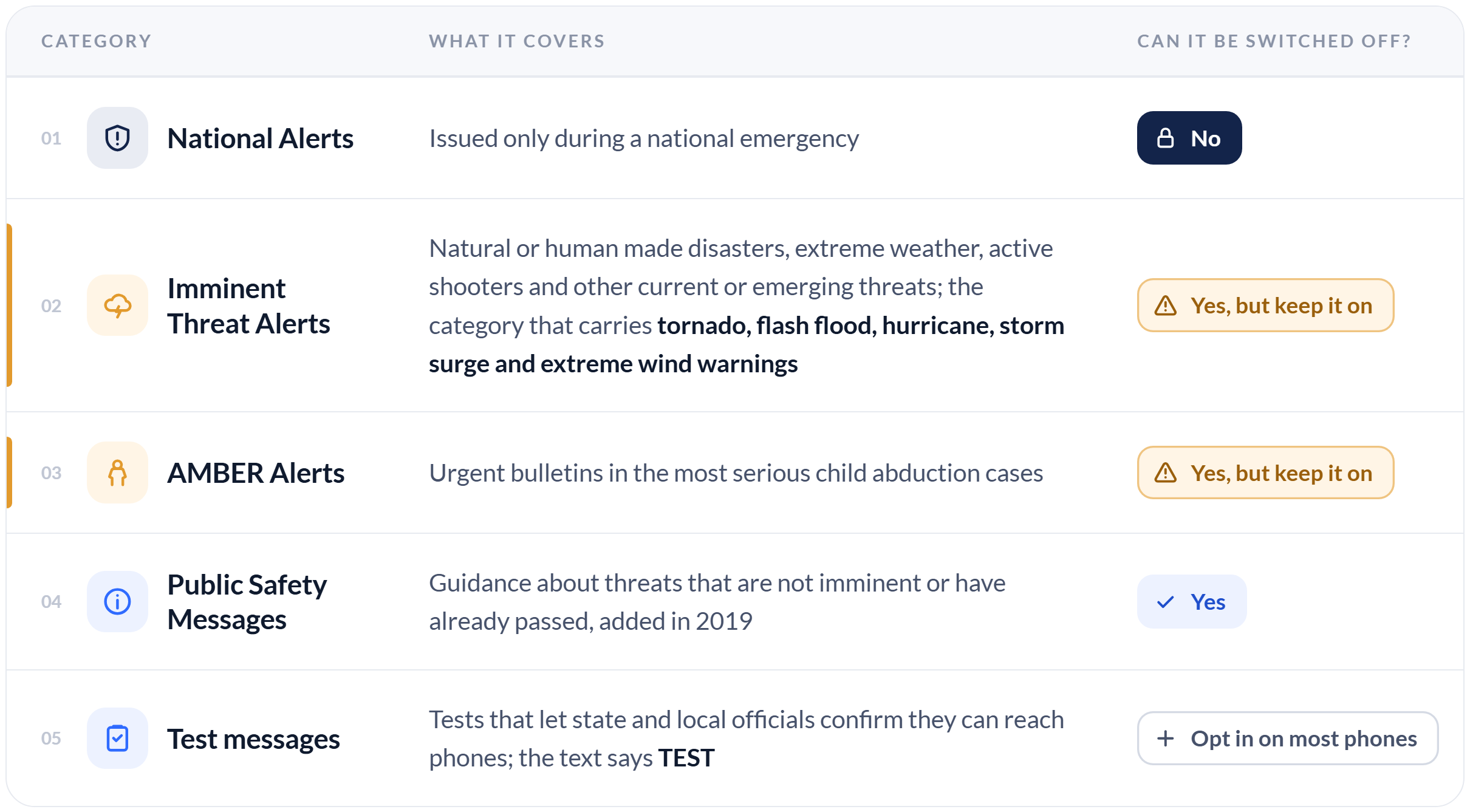
Federal rules allow consumers to opt out of Imminent Threat and AMBER Alerts but not National Alerts, which is why that top category has no switch. On many phones the Imminent Threat category appears as two separate toggles, one for extreme threats and one for severe threats, and both need to stay on. A January 2026 Congressional Research Service report also notes that the FCC adopted rules in 2025 permitting certain alerts to be delivered silently, so an alert that arrives without sound is not necessarily a malfunction.
The attention signal itself is standardized: a special tone and vibration, each repeated twice, followed by a message that looks like a text and shows the alert type, the time, the action to take and the issuing agency.
Who issues the alerts in Florida, and how county systems fill the gaps
Three kinds of Florida originators account for most of the alerts a phone in this state will ever receive: the National Weather Service forecast offices that serve Florida, the Florida Division of Emergency Management and the county emergency management offices authorized to use IPAWS, and the Florida Department of Law Enforcement.
AMBER Alerts are coordinated by FDLE. Its Missing Endangered Persons Information Clearinghouse issues the alert at the request of the local law enforcement agency handling the case, and the WEA goes to phones within a radius of the child's last known location. In a 2023 case described by FDLE, a 5 mile radius produced tips within minutes and the child was found safely in under 30 minutes. Florida established its AMBER Plan in 2000 and was the second state with a statewide plan. Residents who want every alert, including those that do not qualify for a wireless broadcast, can sign up at missingchildrenalert.com for email or text notifications.
Wireless Emergency Alerts are reserved for the most serious situations, which leaves room for a second layer. In 2016 the Florida Division of Emergency Management launched AlertFlorida, a state funded notification platform that counties may adopt at no cost to residents. Marion, Clay and Lafayette counties were among the first to move onto it, and by July 2026 every county in the Panhandle, from Bay and Walton to Okaloosa, Gulf, Franklin, Jackson, Calhoun, Liberty, Holmes and Washington, operated a county alert program that residents can find through the AlertFlorida directory. These programs require registration, and in exchange they can carry county specific notices that would never meet the threshold for a WEA. WEA needs no registration and reaches visitors; the county program reaches the contact information you registered, wherever you happen to be. Florida residents are best served by both.
Why one phone receives an alert and the phone next to it does not
The FCC's consumer guide includes the question of why a friend in the same location received an alert and you did not. The answer usually comes down to one of the following.
The phone was powered off, in airplane mode or without a signal at the moment of the broadcast. Cell broadcast is live radio, and a phone that is not listening at that moment can miss the message.
The phone was outside the targeted area. Alerts are drawn to a specific footprint, and a phone a mile beyond it is not supposed to receive the message.
The phone is an older or incompatible model. WEA requires a capable handset, and the National Weather Service advises checking the device's specifications or contacting the provider.
The alert category was switched off in settings, sometimes months earlier after a loud test.
The provider does not participate. Participation is voluntary, and a provider that does not transmit alerts must say so at the point of sale.
A storm season checklist for Figgers customers
Wireless Emergency Alerts are delivered through cellular networks to capable phones, and the settings that control them live on the handset, so a few minutes with your phone now is the most useful preparation you can do.
Confirm the alert settings. Open the phone's settings and search for "emergency alerts" or "wireless emergency alerts". Make sure Imminent Threat alerts (shown on many phones as extreme and severe threats), AMBER Alerts and Public Safety Messages are switched on. If the menu offers an alert reminder, which repeats the tone at intervals after an alert arrives, turn it on.
Install software updates. The 360 character messages, Spanish language alerts, embedded links and tighter geographic targeting all depend on current software, so an outdated handset can end up receiving the shorter version of the same warning.
Keep the phone charged and carry the charger. The Figgers DragonX ships with a universal 5W charger and carries a 4150mAh battery with AI battery management, but no battery survives a week without power. Keep a charged power bank in the hurricane kit beside the water and the flashlight, and charge everything the moment a watch is issued.
Set up the DragonX emergency call feature before you need it. The feature captures photos and audio and sends a text message to up to four designated people, and it must be configured in advance, which means choosing those four contacts on a calm day in October rather than during a tornado warning.
Register for the second layer. Find your county's program through AlertFlorida and sign up at missingchildrenalert.com for AMBER and Missing Child Alerts.
Test, and call if the test fails. When a state or county test is announced, note whether your phone displays it. If it does not, or if neighbors received a real warning that your phone missed, contact Figgers support, available 24 hours a day, 7 days a week, by phone or text at 1-800-223-5435, by email at Customer.Service@Figgers.com, or by live chat at www.figgers.com, so the handset and line can be checked.
What Florida readers should do next
Check the alert settings on every phone in the household today, including the phones that belong to teenagers and older relatives, because a single switch flipped off in the past is enough to silence a tornado warning. Add the AlertFlorida county registration and the FDLE sign up, charge the kit, and configure the DragonX emergency call contacts while the sky is clear. The next alert will arrive without notice, and the only preparation that counts is the one finished before the tone sounds.
About Figgers Communication Inc.
Figgers Communication Inc. is an American telecommunications company and device manufacturer headquartered in Fort Lauderdale, Florida. Founded by Freddie Figgers, the company provides cellular, mobile broadband, home phone and international calling services without an annual contract, and designs its own phones, tablets, laptops and connected hardware. Figgers customer support is available 24 hours a day, 7 days a week by phone, text and email at 1-800-223-5435 and Customer.Service@Figgers.com, and by live chat at www.figgers.com.